
Scope and method
Every limit on every subcategory is the strictest maximum level set by any credible government worldwide, converted to the product’s native basis, with a disclosed read-across from the nearest government value where no government regulates the exact product. Nothing is invented; every number traces to a named sovereign limit in the regulation references.
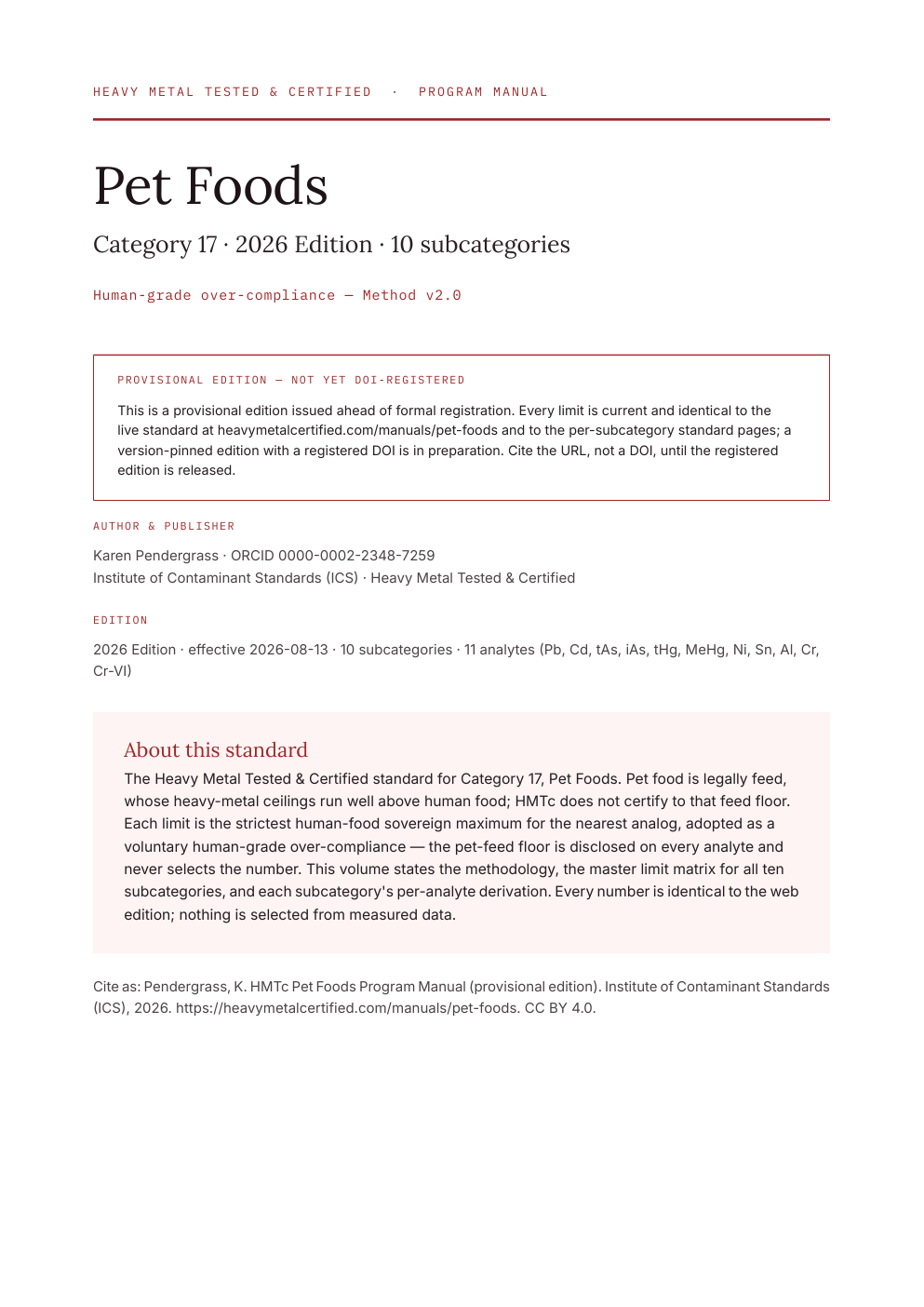
Method: government-limit default (Method v2.0). Pet food is legally feed, not food: its heavy-metal ceilings are set by feed law — EU Directive 2002/32/EC, FDA Center for Veterinary Medicine guidance, and the AAFCO model regulations — whose maximum levels run well above the corresponding human-food limits. HMTc does not certify to that feed floor. Each analyte is set to the strictest applicable human-food sovereign maximum for the nearest human-food analog, adopted as a voluntary human-grade over-compliance; the feed floor is disclosed on every row and never selects the number. Basis is never conflated — dry, as-sold products (kibble, semi-moist, freeze-dried, treats, chews) read across only from dry human analogs, and wet, as-consumed products (canned, raw, toppers, milk replacers, fish-based diets) only from as-consumed analogs, with no wet-to-dry conversion. Every claim analyte is equal at the gate: a product is certified only at or below 100% of each published government floor or disclosed read-across. An exceedance on any metal enters Remediation unmarked; there is no transitional overage. Inorganic arsenic and hexavalent chromium operate as reflex speciation screens bounded by total arsenic and total chromium; methylmercury has no terrestrial biomagnification pathway and is bounded by total mercury; tin is material only for canned product, where it migrates from the tin-coated can, and is controlled by screen — not assigned an invented number — on every non-canned form.
Master limit matrix
All values ppb (µg/kg) in each row’s native basis. Click any subcategory for its full government-by-government derivation. n/m = not material in the matrix; controlled by screen or reflex speciation, not a number.
| Subcategory | Pb | Cd | tAs | iAs | Hg | MeHg | Ni | Sn | Al | Cr | Cr-VI | Basis |
|---|---|---|---|---|---|---|---|---|---|---|---|---|
| Complete & balanced dry (kibble) | 20 | 40 | 100 | 100 | 20 | — | 800 | 250000 | 100000 | 500 | — | as sold |
| Complete & balanced canned / wet | 100 | 50 | 100 | 20 | 50 | — | 800 | 200000 | 100000 | 1000 | — | as consumed |
| Semi-moist pet foods | 20 | 40 | 100 | 100 | 20 | — | 800 | 250000 | 100000 | 500 | — | as sold |
| Raw pet foods (frozen / chilled raw diets) | 100 | 50 | 100 | 20 | 50 | — | 800 | 200000 | 100000 | 1000 | — | as consumed |
| Freeze-dried / dehydrated (including freeze-dried raw) | 20 | 40 | 100 | 100 | 20 | — | 800 | 250000 | 100000 | 500 | — | as sold |
| Fish-based / marine-protein complete diets | 200 | 50 | 1000 | 100 | 300 | — | 800 | 200000 | 100000 | 1000 | — | as consumed |
| Pet treats / snacks | 20 | 40 | 100 | 100 | 20 | — | 800 | 250000 | 100000 | 500 | — | as sold |
| Pet chews (including dental chews) | 20 | 40 | 100 | 100 | 20 | — | 800 | 250000 | 100000 | 500 | — | as sold |
| Toppers / mixers / broths | 100 | 50 | 100 | 20 | 50 | — | 800 | 200000 | 100000 | 1000 | — | as consumed |
| Milk replacers and specialty pet liquids | 20 | 50 | 50 | — | 10 | — | 100 | 250000 | 500 | 300 | — | as consumed |
Risk Flag
These subcategories carry a natural or process background that runs above the limit — the limit being the strictest government maximum for the product, never a percentile of market data (Method v2.0). A product is not disqualified by this: only its own tested result decides certification, and a well-sourced lot can sit well below the market. What the pooled occurrence literature shows is where the work is — which ingredients demand exceptional sourcing.
Lead
Lead is taken up from soil and can enter through adulteration; grains and rice, protein and collagen powders, spices, root and tuber vegetables, and some botanicals are common carriers.
Mercury
Large and predatory fish and other marine ingredients accumulate methylmercury up the food chain.
Cadmium
Cocoa, leafy greens, sunflower and other seeds, organ meats, shellfish, seaweed, and some root vegetables concentrate cadmium from soil and seawater.
Multipliers are the ratio of the pooled occurrence median to the published limit; occurrence characterises the market only and carries no compliance weight. See the cross-category summary.
About this edition
Standards are living, versioned documents; each subcategory page carries its own version history and dated change log. This is the current web edition. A provisional PDF edition of the full manual is available in the rail — its values are current and identical to these pages; a version-pinned, DOI-registered edition is in preparation.
The literature baseline underlying these certification limits is maintained independently at the Heavy Metal Index. This certification standard applies those findings; the two are kept editorially separate by design.