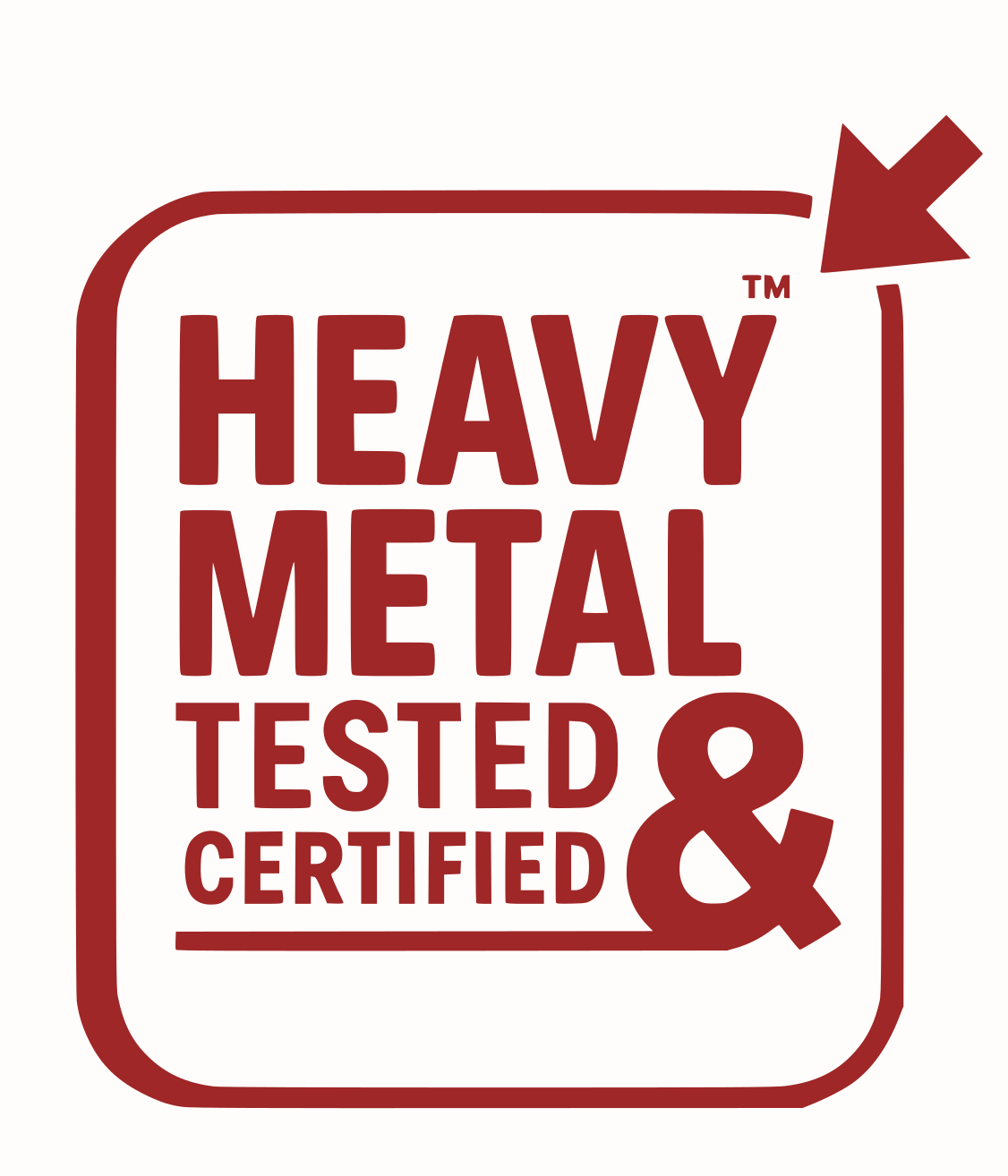
The heavy-metals category will be owned the way non-GMO was: by whoever plants the word and the picture first. Right now the word is unclaimed, the visual is empty, and the demand is already standing in the aisle.
Abstract
In 2009 there was no seal for the question shoppers most wanted answered about their food. A nonprofit with a butterfly changed that in about five years, and in doing so beat a thirty-year-old federal seal at a game the federal seal was never set up to play. This briefing is about how that happened, why it was not luck, and why the same opening is sitting wide open in heavy metals right now: the word unclaimed, the visual undefined, the demand already standing in the aisle.
The word Organic never owned
Start with a fact that should not be possible.
In 1990, organic had everything. A movement thirty years in the making. A new federal law, and soon a federal seal. A word every shopper in America already knew and trusted [2].
The Non-GMO Project had a butterfly. It verified its first products in 2010. Within a few years that butterfly was one of the fastest-growing labels in the grocery store, in a category that did not exist when the organic movement was already middle-aged [1].
How does a butterfly catch a thirty-year head start in five years?
It does not: not if it fights on the leader’s ground. The Non-GMO Project never tried to be a better organic. It did the thing Al Ries and Jack Trout named decades earlier and called positioning: rather than fight for a word someone already owned, find a word no one owns, and take it [5]. Organic owned “organic.” It never owned “non-GMO.” And in the decade when the question shoppers most wanted answered on a label was the GMO question, the word Organic never owned turned out to be the word that mattered.
How a butterfly caught a thirty-year head start
Ries spent a career reducing this to laws, and three of them explain the butterfly.
The first is the Law of the Category: if you cannot be first in an existing category, make a new one you can be first in [5]. Organic was unbeatable as organic, so the Project did not enter the organic category at all. It drew a new line on the shelf, the GMO question, and stood first across it. You do not take the hill the leader is holding. You find the hill no one is standing on.
The second is the Law of Focus, which Ries called the most powerful idea in marketing: own a word in the customer’s mind [5]. The Project owned one. Not “natural,” not “clean,” not “wholesome”: words too broad for any single seal to own. One word, narrow enough to belong to one mark: non-GMO.
The third is the Law of Sacrifice, the one most brands cannot bring themselves to obey. To own the word, the Project gave up everything that was not the word. It promised nothing about nutrition, pesticides, animal welfare, or carbon. It said one thing. A brand that says one thing is remembered for it. A brand that says ten things is remembered for none.
The hammer
A word in the mind is a nail. A nail needs a hammer.
That is Laura Ries’s idea, and it is the second half of why the butterfly won [5]. A verbal position, non-GMO, is abstract, and abstractions live in the part of the mind that forgets. A visual is concrete, and lives in the part that does not. The image drives the word in and holds it there.
The butterfly is close to a perfect hammer. It is a single, specific image, a monarch, not a generic insect, so it is ownable; no one else can use it without summoning the Project. It is simple enough to read at thumbnail size on a crowded package. It is emotional: delicate, natural, faintly endangered, which is precisely the register the GMO concern trades in. And it is not arbitrary: the monarch is a creature whose own decline has been tied to the herbicide-tolerant agriculture the label exists to flag. The picture carries the argument. Laura Ries’s point is that the brands that win are rarely the ones with the best words. They are the ones whose word arrives fastened to an image you cannot put down.
The empty position in heavy metals
Now look at heavy metals, and look at it the way Ries would.
The demand is already there. Demand is the part of a new category that normally has to be manufactured, and here it has manufactured itself. A unanimous Supreme Court has put baby-food heavy metals on the front page. California and Maryland now require testing and public disclosure, and the exposés arrive on a schedule [4]. A parent at the shelf is already carrying the heavy-metals question in her head. What she does not have is a seal that answers it.
Because no one owns the word. Look at what is actually on the package. Organic owns production methods and is silent on metals: organic cocoa, organic rice, and organic root vegetables carry them like everything else, because the metals come from soil and water, not from farming method [3], [6]. Non-GMO owns the gene and is silent on metals. The broad “clean label” marks do test for metals, but they test for metals among a dozen other things, and a mark about everything cannot own one word. That is the Law of Focus running in reverse [6]. And there is no butterfly. The category has no visual hammer at all. The verbal position is open. The visual position is empty. The demand is standing in the aisle with nowhere to land.
This is the 2009 of heavy metals. The category already exists in the customer’s mind and not yet on the shelf. That gap between the two is the most valuable thing in marketing, and it never stays open for long.
The standard built to own it
A position does not occupy itself. Someone steps into it, or it sits empty until someone does. The Heavy Metal Tested & Certified program was built to step into this one, and it was built, deliberately or not, along Ries’s lines.
It owns the words. The name is not a brand laid on top of a category; it is the category. Heavy Metal Tested & Certified. There is no translation step between what the seal is called and what the shopper wants to know. Ries’s ideal name is the one that vanishes into the category it names, and this one does [5].
It is focused. It certifies one thing, eight metals in infant and child food, and claims nothing about the hundred other things a food can be. It says only that a product was independently tested against published limits under ongoing surveillance; it is forbidden from saying “safe,” and does not [6]. By the Law of Focus, that narrowness is not the limitation it looks like. It is the entire asset.
It is first in the way that counts. Ries’s Law of Leadership holds that it is better to be first than better, and the first that decides a category is first in the mind, not first in the factory [5]. The position goes to the first credible, defensible, methodology-published standard that a brand and a regulator can both stand behind, and that is the race actually under way [6].
And it has a hammer, though the hammer is young. The mark is the category’s own name rendered as a heavy, black, unmistakable wordmark: heavy metal set in the literal weight of the words, carrying the double meaning that makes a thing stick. It owns the word on the page the way the butterfly owns it in the air. The pictorial hammer for this category, the heavy-metals equivalent of the butterfly, has not been claimed by anyone yet. That, too, is a position sitting open, and the standard that owns the word is the one in line to claim it.
Who owns it
Categories get owned. That is not a forecast; it is a pattern without a counterexample. Someone owned organic. Someone owned non-GMO. Someone owned gluten-free, and fair-trade, and cage-free. In each case the owner was not the largest company or the best product. It was whoever planted the word and the picture first, and then refused to let go.
Heavy metals will be owned the same way. The concern is too real, and now too permanent, for the category to stay nameless. A seal will come to mean this one was tested, parents will look for it the way they look for the butterfly, and the brands wearing it early will turn out to have been wearing it since before it was expected of them.
So the question this briefing leaves you with is not whether the heavy-metals category will be owned. It will. The question is the one Seth Godin tends to ask at the end of things: now that you can see it, what are you going to do about it?
The category of heavy metals will be owned. The only question is by whom, and which side of that sentence your brand is standing on.
Karen Pendergrass is the Standards Architect of the Heavy Metal Tested & Certified program at the Institute of Contaminant Standards (ICS). She can be reached at karen@paleofoundation.com. This briefing is a positioning analysis offered for independent evaluation; it is not a representation about any other certification program, each of which has its own legitimate scope.
References
Works cited in this briefing’s text, in first-appearance order. This is not the full evidence base for the underlying standard; it is only what the prose above draws on. Every range in the briefing is a model built on one of these published anchors. Where a work carries a DOI or a public URL, its title and domain link to it; primary legal documents and published standards are named but not linked to a corpus record.
(first verified products, 2010). Industry sales-tracking data (SPINS; Nielsen) reported Non-GMO Project Verified among the fastest-growing label claims in the natural and grocery channels through the 2010s. Figures are the program's and the trackers' and are cited here for the positioning pattern, not as an audited comparison of seal counts.
U.S. Department of Agriculture; the Organic Foods Production Act of 1990 and the USDA Organic seal (in use from 2002). USDA Organic certifies agricultural production methods and does not address heavy-metal contamination at the product level.
U.S. Food and Drug Administration (lead detected in 15% of samples, arsenic 43%, cadmium 33%, mercury 10%) — heavy metals are endemic to the food supply, including organically grown food, because they originate in soil, water, and atmospheric deposition rather than in farming method.
607 U.S. ___ (No. 24-724), decided Feb. 24, 2026; California Assembly Bill 899 (2023) and Maryland "Rudy's Law," HB 97 / SB 723 (2024) (baby-food heavy-metal testing and disclosure); U.S. House Oversight Subcommittee Staff Report, Feb. 4, 2021. Together these establish present, growing consumer-facing demand around the heavy-metals question.
No source record — primary legal document, not corpus literature
A. Ries and J. Trout; A. Ries and J. Trout, The 22 Immutable Laws of Marketing (the Law of Leadership, the Law of the Category, the Law of Focus, the Law of Sacrifice, the Law of the Mind); L. Ries, Visual Hammer (the visual hammer as the image that drives the verbal position into memory). Concepts are referenced and paraphrased; the framing of this briefing is an application of them.
K. Pendergrass, 2026 Edition, the Institute of Contaminant Standards (ICS). doi: 10.5281/zenodo.20270512. Heavy-metal-specific scope and the recognition framework comparing HMTc to USDA Organic, the Non-GMO Project, the Clean Label Project, EWG, and Consumer Reports (Organic and Non-GMO have no heavy-metals scope; "clean-label" marks cover metals within a broad multi-contaminant scope): Part 5.5. Mark-usage rules, the focused single-concern claim, and the prohibition on safety-implying language ("does not certify safety"): Part 2.5 and Part 2.1. · doi.org↗
Bibliographic record
The fields an indexing service reads. Title, named first author and year are the three that carry the record; a briefing missing any one of them is treated as carrying no metadata at all.
The three peer-track preprints are deposited with DOIs; the briefing series is not. Depositing the briefings would make each independently resolvable after any URL change: worth doing for the documents most likely to be cited.
Cite this briefing
Pendergrass, K. (2026). The Open Category: The Non-GMO Project Owned a Word Organic Never Did. Heavy Metals Is the Next One. (HMTc Standards Briefing). Institute of Contaminant Standards (ICS).
Prose CC BY 4.0. Direct reproduction of substantial portions requires written permission from Institute of Contaminant Standards (ICS)